
A Compilation of His Words on Unity, Security, Integrity, and a New Nigeria
A Compilation of His Words on Unity, Security, Integrity, and a New Nigeria
🇳🇬Unity & National Identity
“No tribe buys bread cheaper.”
With this line, Peter Obi seeks to highlight what unites all Nigerians: the mismanagement of government affects everyone equally. As he often elaborates, there is no road on which only Muslims travel and no hospital that serves only Christians. He uses the point to argue that Nigerians should work together as one people, rather than allow themselves to be divided along ethnic and religious lines.
“I want to unite and rescue Nigeria. Our government will be a government of love and unity.”
Peter Obi has made it clear that he is on a mission to unite and rescue a country he sees as divided along ethnic and religious lines — divisions that, in his view, have served only the interests of elites and rulers. He has said his government would treat Nigerians as one family, with top priorities in security, the rule of law, education, healthcare, and lifting people out of poverty. He has also pledged to cut the cost of governance and redirect the savings toward national development
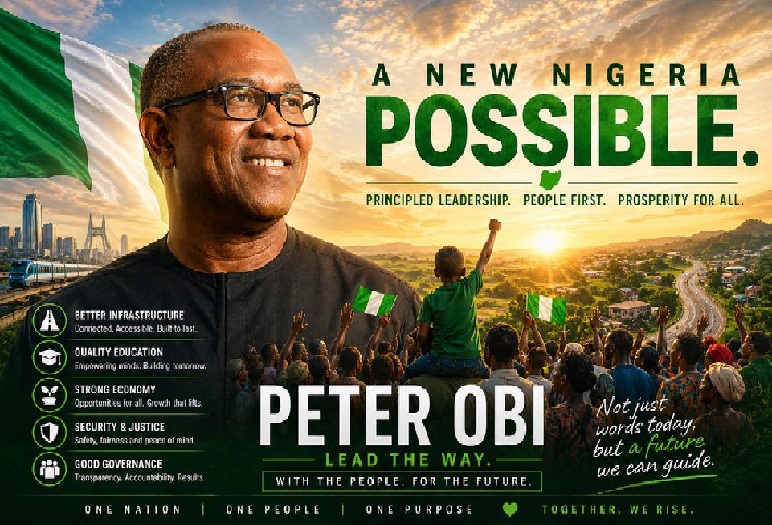
“A new Nigeria is Possible”
One of the earliest mantras of the Obidient movement, which began in 2022, this phrase captures Obi’s claim to represent positive change. His record as governor, his supporters argue, was stellar, with no corruption or criminal cases against him. Were he elected, he would also be the first Nigerian president sworn in who was born after the country’s independence on 1 October 1960 — a fitting coincidence, his backers note, given that Obi was born on 19 July 1961, roughly nine months after independence, “a gift toward a New Nigeria.”
What does a “new Nigeria” mean in this vision? A Nigeria free from corruption, where public funds are used for the public good; where the poor, the sick, and the needy are cared for; where things work, criminals are prosecuted, and the rule of law is upheld; and where, in his signature formulation, “the child of nobody can become somebody without knowing anybody.”
“As long as there is a Nigerian in an IDP camp, Nigeria is in an IDP camp”
Obi has personally visited more than ten internally displaced persons (IDP) camps across Nigeria and presents himself as a leader who genuinely cares for the people. As governor of Anambra, he points out, he ensured that those living in IDP camps in the state were safely returned home. He has consistently called on the government to do what is necessary to return displaced Nigerians to their communities and has committed that, as president, he would tackle the insecurity — including banditry — that drives displacement.
“If there is trouble in Nigeria and I am out of the country, I’ll leave where I am and return. I have only one passport; I am ready to die for Nigeria.”
Peter Obi is a self-made millionaire in dollar terms and, by naira valuation, a billionaire. He lived in the UK for several years, purchased a home outright, and was able to borrow millions from banks on the strength of his own name. He attended top schools across the globe. Yet despite all this, he has chosen not to acquire the citizenship of any other country. His commitment, he says, is first to Nigeria — and if push comes to shove, he is willing to die for a better one. For millions of young Nigerians, the hope is that he realizes his ambition of becoming president rather than a martyr, and finally brings civility into governance — something they argue is missing in Nigeria today.
Security & Governance Authority
“Bandits cannot be stronger than government. It’s either government is in charge or the bandits are in charge, and I’ve said it: as President, I will be in charge.”
Today, several Nigerian states are plagued by banditry, with Niger, Borno, Benue, and Plateau among the worst affected. The causes, Obi argues, are multi-pronged: lack of education, the theft of mineral resources, and deliberate efforts to destabilize the government. Asked how he would respond, he answers emphatically that bandits cannot be stronger than the government — one side must be in charge, and as Commander-in-Chief, he would lead from the front, even if it means going into the forests where kidnap victims are held. As governor of Anambra, he points to a record of direct action: the demolition of houses used to hold kidnap victims, provision of equipment, training, and personnel to security agencies, and the leveraging of intelligence. He commits to doing the same as president.
“None of you here — nobody — can steal oil. It is the government.”
In Nigeria, fuel subsidy has long been a bone of contention. When President Goodluck Jonathan attempted to remove the subsidy in 2012, many figures in the then-opposition — including the current president — protested the move, when petrol sold for ₦97 per liter. Yet the subsidy regime has also, Obi argues, a means of looting the treasury, with numbers inflated and spending exaggerated. All major candidates in the 2023 election committed to removing the subsidy; Obi was distinctive in how he said he would do it. He pledged to remove the corruption embedded in the subsidy regime first, and to ensure that whatever money was saved would be properly accounted for to the Nigerian people.
“The structure that they have now is a structure of criminality.”
When Peter Obi began campaigning in 2022, his opponents claimed he had no “structure.” One former governor and APC leader went so far as to say Obi’s supporters were “four people tweeting in a room” — a claim massively debunked by one-million-man marches in virtually every state of the federation, and by Obi’s haul of more than six million votes in the 2023 election (even as, his supporters allege, his true numbers were substantially reduced). Obi’s retort is that the establishment’s “structure” is a structure of criminality — one that does not want Nigeria to progress and keeps the country down. The real structure, he says, is the Nigerian people themselves. He adds that those who profit from the old order will do everything within their power to resist positive change.
“The problem we are seeing now is a result of cumulative leadership failure over the years.”
Obi diagnoses Nigeria’s core problem as a cumulative failure of leadership — government repeatedly failing in its responsibility to its citizens. He urges the people to “take back the country” from those running it, and warns the government and elites that “anarchy consumes everybody.” Preaching to the heart of the problem, he argues that the people called bandits today are those whom the nation failed to educate and lead rightly yesterday.
Integrity & Track Record
“If you find anywhere where I misappropriated public funds, I’ll stop campaigning.”
One of Obi’s most discussed traits is frugality — some call it stinginess. He defends the label, saying he is not stingy but frugal, and that money should be used for responsible purposes. On public funds he has been emphatic, on multiple occasions, that public money must be used for the public good. His record as governor, he argues, speaks for itself: savings of over $150 million and ₦75 billion, achieved while still investing in health, education, and poverty reduction. Evidence of this, he notes, includes the largest single purchase of HP computers in Africa (over 22,500 laptops in a go, and 30,000+ total), the Bill & Melinda Gates Foundation prize for best-performing governor in polio eradication in the South-East (2013), and top performance in implementing the UN Millennium Development Goals (Best Governor in MDGs Implementation, Nigeria, 2014). He paid outstanding and current pensions and gratuities and still left savings and investments for the state.
“Go and verify.”
Another signature mantra of the 2022–2023 campaign season. Among Obi’s gifts is his use of facts, figures, and analogies to make his point, and with every claim he invites his audience — and his critics — to verify it. In a political culture where politicians expect to be taken at face value, Obi goes the other route: scrutinize everything I say. He has compared Niger State, one of the states worst hit by banditry, to the Netherlands: Niger State covers roughly 76,000 square kilometers, while the Netherlands, excluding its water bodies, covers about 33,000 — yet the Netherlands earns some $120 billion from food exports annually, while Niger State cannot produce enough food to feed itself, despite sitting on fertile, arable land. He has drawn similar comparisons with Egypt, India, and South Africa, which each grew power generation by tens of thousands of megawatts in roughly five years, while Nigeria — after more than a decade under the same ruling party — has little to show in power generation. He cites Indonesia too, and its dedicated ministry for small and medium enterprises, as a model for driving growth through the sector he calls the engine of the economy.
“I am not a saint, but I am also not a thief.”
Obi makes no claim to sainthood — no human can, he says — but he insists he has proven unequivocally that he is not a thief. In his own words, no thief sees what he can steal and leaves it. As governor, nobody asked him to save money; he did so of his own free will. Nobody asked him to cut the cost of governance; he did it of his own free will. Nobody asked him to invest in local manufacturing, such as Innoson Motors; he did it of his own free will. Nobody asked him to scrap the office of the First Lady; he did that too, calling it unconstitutional and a source of confusion — he and his wife, he notes, are happily married and share a home. Measured against most other governors and Nigerian leaders, his supporters argue, he stands apart. He may not be a saint, but in the Nigerian political context, it is not far-fetched to call him one — which is why some followers affectionately refer to him as “Saint Obi.”
“I took education from No. 26 to No. 1 as governor of Anambra. I wasn’t owing pensions, gratuities, or contractors who had completed their work… I draw no pension from the government. Governance should be about service.”
Here Obi recites some of his achievements as governor of Anambra State (2006–2014). Education has always been — and remains — his top priority. Indeed, one of the things that spurred him into politics was returning to his state and finding students at home for over a year; he knew something had to be done and that he had to get involved. For Obi, politics is service to the people. Even today, as a private citizen, he continues to donate millions of naira — billions cumulatively — to nursing schools, hospitals, IDP camps, and any cause he can support as part of his personal contribution to Nigeria.
Leadership Philosophy & Humility
“I am not desperate to be president; I am desperate to see Nigeria work.”
His critics in the APC say Peter Obi is desperate. The counter thought: who is truly desperate — someone who has sought the presidency since 1999, someone who declared “Emi lo kan” (“It is my turn”), or someone who says he merely wants to see a working Nigeria? Obi has contested the presidency only once (2023) and will make his second — and, he suggests, final — attempt in the 2027 general election. He states, emphatically, that among the candidates running, he is the most qualified, judged by antecedents and track record. This, he insists, is not desperation but a simple placing of his records on the table — and anyone seeking the highest office must be able to show proof of work.
“Do not vote for me because I am an Igbo man. Do not vote for anybody because he is from the West or from the North. This is the time to vote for a human being based on compassion and trust.”
Voting, Obi argues, should be based on character we can trust, compassion, capacity, and commitment to doing the right thing — what he calls the 5 Cs of a good leader:
- Character — a leader must have exemplary character, including integrity and accountability.
- Commitment — a leader must be committed to the goal.
- Compassion — a leader must have compassion for the people he or she governs.
- Capacity — a leader needs the capacity, in strength, wisdom, and otherwise, to lead.
- Credibility — a leader must be credible and able to show basic facts such as age, qualifications, and background.
Obi says he does not want votes cast on tribal or religious sentiment, which he describes as the trick elites use to divide Nigerians along ethnic lines — a trick employed, he argues, precisely because they have nothing else to offer. The next leader of Nigeria, he says, should be chosen on the 5 Cs.
“I want to listen and learn. Leadership is about listening to the people.” | “I don’t know everything. I want people who will tell me I am wrong.”
Obi is well travelled and well versed, particularly on the topics that concern Nigeria and governance. He makes himself available for scrutiny, fields a relentless stream of questions, and reliably provides answers. Yet he is also the first to say he does not know everything — that a leader’s job is to listen and learn, and that where he is wrong, he wants the people to point it out. This is humility at its finest.
“If you must be called Excellency, then the road through which you got there must be excellent.”
Obi made this statement in the aftermath of the 2023 general election, which was marred by widespread irregularities: vote-rigging, ballot-snatching, missing data on the INEC results-viewing (IReV) portal, and voter intimidation, among others. He has stated clearly that the process through which people attain office is far more fundamental than what they do thereafter. He has said categorically that he will not buy a single vote — he does not “give shi-shi” — which is why his campaigns have been mass-driven, with supporters contributing their time, energy, and resources because they believe he is the best fit for the job. He has called on INEC and all those responsible for conducting the 2027 election to guarantee a free, fair, and credible process, pledging to accept whatever the people decide under those conditions. Again, the message is that Obi himself is not desperate to become president; rather, it is the people who are desperate to see him become president. He has warned that whoever fails to count the people’s votes will themselves be counted, and his supporters have independently declared that no voter intimidation will be tolerated this time.
“I’ll be there — not through proxy.”
As a leader who leads from the front, Obi says he will be present. When schoolchildren are kidnapped, he will go to see what happened. When a major crisis strikes the country, he will be there to know what is going on. He has demonstrated this both as governor and as a private citizen, visiting virtually all the states and engaging with elders, communities, students, and ordinary citizens. He will not lead or speak through proxies; he will make himself available to answer questions directly and hear from the public. The buck stops at his table, and he will be responsible for the affairs of the government.
Corruption & the Economy
“If you, the head, are not stealing; your wife and children are not stealing; those around you are not stealing — you reduce corruption by over 50%.”
Asked how he would fight corruption — a plague, as he describes it, in today’s government — Obi answers that the fight begins at the top. If the head is not corrupt, it becomes far easier to deal with corruption in the body. In his formulation, if you are not stealing, your wife and children are not stealing, and those around you are not stealing, corruption is already reduced by more than half. Fighting corruption therefore begins with living an exemplary life worthy of emulation; prosecuting those who break the law; upholding law and order, an intangible asset essential to growth and investment; and making every state viable through agriculture, finance, manufacturing, SME growth, and infrastructure — which in turn reduces Nigeria’s dependence on oil, a goal he says his administration will pursue relentlessly.
“Any country where politicians are richer than businessmen and entrepreneurs is a failed state.” | “Corruption kills three things: professionalism, hard work, and entrepreneurship.”
Still on corruption — which has plagued Nigeria since independence — Obi argues that any nation where politicians are richer than the businessmen and entrepreneurs who create value is a failed state. Corruption, he says, kills professionalism, hard work, and entrepreneurship, because people earn without producing value: contracts are inflated or awarded for projects never executed, with the allocated funds simply pocketed. He pledges to fight corruption head-on. He offers a pointed comparison: university professors in Nigeria earn roughly ₦400,000–₦900,000 per month (about ₦4.8–10.8 million per year), while a local government chairman — the lowest tier of executive office — earns average salaries and allowances of ₦1.5–3 million per month (₦18–36 million per year), with requirements as modest as a secondary school certificate or a bachelor’s degree and age 30. To become a professor, by contrast, one must complete a master’s degree and a PhD and teach and publish for many years. This, Obi suggests, is one of the principal reasons those in government dislike him: they know he would overhaul the system and conduct a thorough review of salaries and compensation across the federation, including ministries and executive bodies.
“We can earn more money from agriculture than we earn from oil.” | “From consumption to production.”
Obi wants to move Nigeria from a consuming nation to a producing one. Today the bulk of government revenue comes from crude oil exports, but it was not always so. In the 1950s and 1960s, Nigeria’s major income earner was agriculture; over the years, that sector — along with steel and manufacturing — was largely abandoned as excess oil money flowed in. For a time, in the 1970s through the 1990s, the arrangement worked well enough: Nigeria’s population was far smaller than today’s, and while the government was corrupt, it was not as corrupt as it is now. Nigeria’s wealth even supported other African countries — a past leader famously remarked that Nigeria had “so much money, we don’t know what to do with it.” Hard to imagine today, when Nigeria has been described as the poverty capital of the world, with more than 20 million out-of-school children and over 100 million living in extreme poverty, unsure where the next meal will come from. The country, in short, fell into the “oil curse”: overreliance on a single export without diversification.
Obi intends to fix this through diversification: investing in agriculture and human capital, opening up seaports across the country, and building critical infrastructure — power, rail, and roads. He cites Bangladesh, which earns more from exporting textiles and clothing (roughly $39 billion) than Nigeria earns from crude oil (roughly $31 billion) [both 2025 FY data], as proof of what is possible.
The Future & Forward-Looking Vision
“It is about the future of the youths.”
Obi presents himself as a leader who deeply cares about Nigeria’s young people — children, youth, and young adults — seeing them as the engine of change and economic growth. He often says it is about the future of the youths, and that the nation cannot bequeath anarchy to the young. He surrounds himself with young adults, wanting them eventually to take over the mantle of leadership. Recently he appeared on a TikTok live that drew over five million views and ranked among the most popular live spaces globally for that 24-hour period. He has hosted numerous X Spaces, town halls, and youth programmes to spread his message and inspire the young. With roughly 60% of Nigeria’s population in the productive age bracket of 18–40, Obi wants to harness that talent and build an environment where skills meet opportunity. The diaspora is not left out either: he argues that the brain drain can become a brain gain for the Nigerian economy, noting that diasporans are typically the first investors when an economy starts improving, bringing both capital and experience back home.
“I won the 2023 election, but I don’t want to go back to the past.” | “The one looking back will miss what’s in front.”
Perhaps his most controversial statement. Obi and his supporters believe he won the 2023 election and was rigged out. Obi further claims he won Rivers and Benue states, alleging the figures were cooked up to favour the APC candidate and now president, and insists that the authentic Rivers numbers showing his victory remain visible on the IReV collation portal. Government officials reportedly claimed Obi scored over 900,000 votes in Lagos, with Bola Tinubu below 150,000 — yet the final declared result showed a close race, with Obi at 582,000 and Tinubu at 572,000.
The election result was contested by both Obi and the PDP candidate, Atiku Abubakar, but the appellate court and the Supreme Court ruled in favour of the APC candidate. In Obi’s telling, the courts ignored numerous irregularities, including:
- Unverified or allegedly falsified educational credentials of the APC candidate;
- The candidate not meeting the constitutional requirement of 25% of the vote in the FCT (Abuja);
- A 1993 US forfeiture of $460,000 linked to heroin trafficking;
- Voter intimidation, voter suppression, vote-buying, and other irregularities;
- Missing IReV upload data;
- Findings of the European Union Election Observation Mission (EU EOM), which documented: ambiguities in electoral law; operational failures by INEC; poor transparency, especially in real-time publication of results; low public trust in electoral administration; security challenges; discrimination against women in politics; and impunity for electoral offences.
Obi insists he won the 2023 election, and his supporters maintain his mandate was stolen. Whether the full story of that election will ever come to light remains to be seen. This time, he has framed the upcoming contest as a battle between Nigerians and the government, urging voters not merely to cast their ballots but to follow them through ward, local government, and state collation centres to defend their votes. He insists he won in 2023 but does not want to dwell on the past — he is more concerned about the future — even as he demands a free, credible, and transparent election from the government.